


Autism@Manchester research involvement toolkit
The aim of the Toolkit is to encourage more people to become involved in research as both public contributors, supporting the design and conduct of research, and as research participants
The information in this toolkit is aimed at autistic people, their supporters, and others who experience barriers to inclusion in research. For example, during evaluation, people we interviewed with mild to moderate mental health conditions also found the toolkit useful. This is a free, online learning resource with no need to sign-up or login. The toolkit can be viewed at any time and for any duration.
The toolkit contains four modules and a glossary. You can read whichever module is of interest, in any order, although they have been written in the following order:
- Module (1) Understanding the Research Process is for anyone interested in research, it explains what the different stages of research are and invites readers to think critically about the different forms of autism research.
- Module (2) Taking Part in Research as a Participant explains how to become a research participant and what you might expect to happen during this process.
- Module (3) Understanding Research Findings looks at how research is shared, how you can check the reliability of research, and how the media has shaped views of autism – providing tools to interrogate sources of information.
- Module (4) Getting Involved in Research Co-Production is all about how to become a research contributor, which differs from volunteering as a participant as contributors are invited to shape research from their lived experiences.
In the glossary, terms used in research and acronyms are explained.
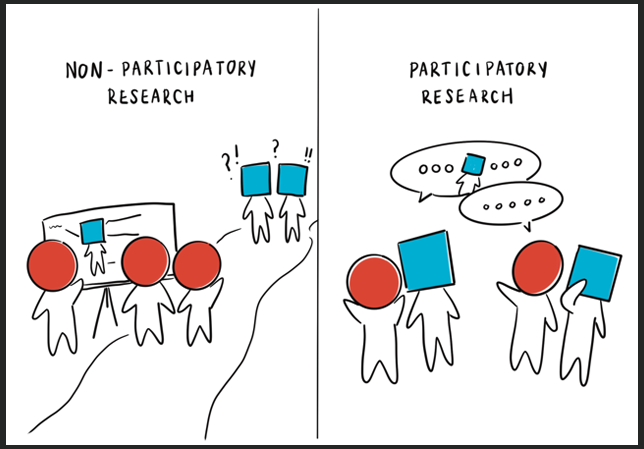
*The cartoon shows researchers (with round heads) and the people they are researching (shown with square heads). On the left, non-participatory research is depicted as the researchers looking at the public participants from afar. The participants are stood apart from them, uncertain of the research (shown through exclamation and questions marks). On the right, we see the researchers and participants together, openly discussing the research. This is the how we wish to involve more autistic people with research for and with them, not simply about them.
- Autism@Manchester copyright, illustrated by Jaja Choktanasiri.
How was the toolkit created and who was involved?
The toolkit idea initially came from a project developing these guidelines for researchers working with autistic people. Autistic people told us that they wanted to get involved in research but often did not know how to or could not access research findings. Prof Emma Gowen, Dr Alexandra Sturrock, Dr Kathy Leadbitter and Autism@Manchester’s Co-production Officer, Jaja Choktanasiri, began to develop the toolkit.
In 2024, we received University of Manchester Research Institute’s Interdisciplinary Research Pump-Prime fund to support our work on addressing autistic health inequalities. The toolkit was further developed as a part of this project, as we identified that barriers to autistic health equity begins with the absence of the meaningful involvement of autistic people with research. Dr Erin Beeston joined the team as Research Associate and Autism@Manchester Co-Production Officer, along with Dr Kelly Birtwell, an experienced health researcher from the School of Primary Care, and Matthew Jackson from the University of Manchester’s e-learning team.
The team worked together to realise and evaluate the toolkit from 2025 to 2026, supported with Patient and Participant Involvement and Engagement funding from the NIHR Three Schools Mental Health Programme. They were joined by lived-experience PhD student, Elizaveta Nosova, and Dr Alice Dunning at the School of Medicine and Population Health, University of Sheffield who guided us with mental health research perspectives. The team refined the toolkit with the valuable input of public contributors, suggestions from focus group participants, and the help of Autism@Manchester’s intern - Matthew Kasper. We also received feedback from health and clinical researchers: Thabitha Charles at Manchester University NHS Foundation Trust and Lisa Miles at the Biomedical Research Centre. Bean Sharp in e-learning provided key support with finishing the toolkit. Members of the Autism@Manchester expert by experience group provided feedback on drafts at all stages of Toolkit development.
We would like to thank all our collaborators for the care and effort they put into contributing to the toolkit.